Hydro Jetting for Restaurants: A Practical Guide
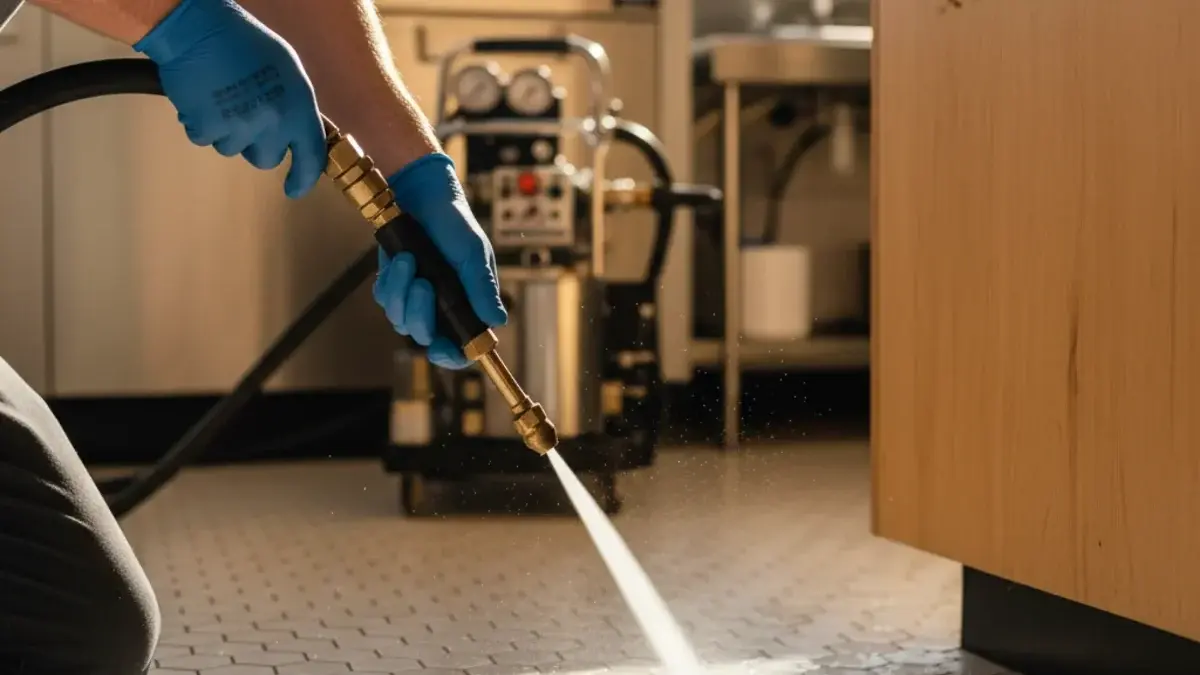
Quick answer: Restaurant hydro jetting uses high-pressure water to clear the grease, food waste, and sludge that build up in commercial kitchen lines, floor drains, and grease lines. Because restaurants generate enormous fats-oils-and-grease (FOG) loads, these lines clog faster than residential ones — and a backup during service means lost revenue and possible health-code issues. Regular jetting, scheduled around service hours, keeps the lines clear and the kitchen open.
Why restaurant lines clog so fast
Hot grease washes down as a liquid, then cools and hardens on the pipe wall into a thick, sticky layer that progressively chokes the line and traps food solids. Even with a grease trap, FOG accumulates downstream. A cable auger bores through it; jetting removes it entirely.
The sheer volume is what sets restaurant lines apart. A busy kitchen can send more fats, oils, and grease down its drains in a single week than a household produces in a year — from fryers, grills, sauté stations, and the dish pit all at once. That constant FOG load, combined with food solids and high water volume, coats and narrows the line far faster than any residential drain, which is why restaurant lines need a fundamentally different maintenance approach.
What jetting clears that snaking can't
The defining problem in a restaurant line is hardened grease bonded to the full circumference of the pipe — and that's precisely what a cable can't address. A snake bores a hole through the center and leaves the grease layer intact, so flow returns briefly and then chokes again. Hydro jetting's high-pressure water emulsifies and strips the grease off the entire wall and flushes it downstream, restoring the pipe's full diameter. For grease specifically, jetting isn't just better than snaking — it's really the only method that removes the cause.
Scheduling and prevention
The most effective approach is preventive: jetting grease-heavy lines on a regular schedule (often quarterly to semi-annually) so they never reach the backup stage. We work before opening, after close, or during slow periods to minimize disruption. Pairing this with grease-trap maintenance and good kitchen habits keeps lines reliably clear.
Scheduling around service is central to how we work with restaurants — late nights, early mornings, or slow afternoons so the kitchen keeps running. And the prevention stack matters: staff habits (scraping, dry-wiping, screening) keep most FOG out, the grease trap captures much of the rest, and periodic jetting clears whatever still reaches the lines. Together they keep a kitchen open and out of the emergency-callout cycle.
The cost of getting it wrong
A grease backup during a packed Friday service is the scenario every operator dreads, and the cost dwarfs any cleaning bill: a closed kitchen, comped or canceled orders, a potential health-code violation, and an after-hours emergency premium all at once. Against that, a scheduled jetting interval is a small, predictable expense — which is why established restaurants treat it as routine maintenance, not an optional extra. Call (207) 419-2600 to set up a schedule built around your service hours and volume.
When to call a professional
If a clog keeps returning, more than one drain is slow, or you're dealing with backups, odors, or roots, it's time for a professional look. A camera inspection pinpoints the cause and confirms whether hydro jetting is the right fix — call (207) 419-2600 for fast local service in Sterling Heights and nearby Metro Detroit.